
A statement of purpose (SOP) is often the only place in your application where a committee hears your voice. Grades and test scores show what you have done, but the SOP explains why you are applying, what you want to study, and why you are worth funding. A focused, well-structured SOP can lift an average profile, while a vague one can sink a strong candidate.
What Scholarship Committees Look for in an SOP
Committees read SOPs quickly, often in a few minutes each, so clarity matters more than elegant writing. They want to see a credible academic and career direction, backed by evidence from your past. Every paragraph should help answer the question: why should we invest in this person?
These are the qualities reviewers score most often:
- Clear purpose:A specific field, research question, or career goal, not a general interest.
- Evidence of preparation:Courses, projects, research, or work that show you are ready.
- Fit with the programme:Named faculty, modules, labs, or resources that match your goals.
- Motivation and impact:Why this matters to you and how you will use the degree.
- Writing quality:Clear, error-free English with a logical flow.
SOP vs Personal Statement vs Motivation Letter
An SOP focuses on your academic and professional goals, and it is common for US, Canadian, and many Asian graduate programmes. A personal statement leans more on your background and personal journey, while a motivation letter, common in Europe, explains why you want a specific programme or scholarship. Always read the prompt, because some schools use these terms interchangeably.
Free SOP Template for Master’s Applications
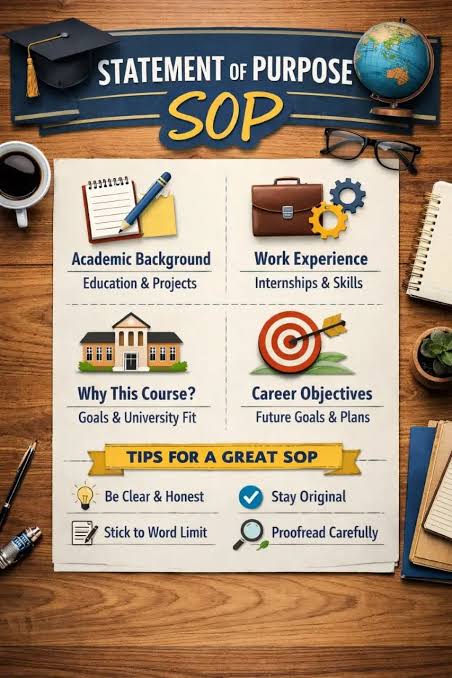
Most master’s SOPs work best at around 800 to 1,000 words, unless the programme sets a different limit. Use the five-part structure below as a framework, then fill each part with your own specific details.
- Opening (1 paragraph):Start with a concrete moment, problem, or project that led you to this field, and state your goal in one clear sentence.
- Academic background (1 to 2 paragraphs):Highlight the courses, projects, or thesis work most relevant to the programme, with results.
- Professional or practical experience (1 paragraph):Describe internships, jobs, or volunteer work that built relevant skills.
- Why this programme (1 paragraph):Name specific modules, faculty, labs, or opportunities, and explain how they fit your goals.
- Career goals and closing (1 paragraph):State your short- and long-term plans and how the degree helps you get there.
Free SOP Template for PhD Applications
PhD SOPs focus much more on research. Committees want to know that you understand what research involves and that your interests match their faculty.
- Research interest (1 paragraph):Introduce the specific problem or area you want to work on and why it matters.
- Research experience (2 paragraphs):Describe your past projects, methods, findings, and any publications or presentations.
- Skills and preparation (1 paragraph):Summarise technical, analytical, or lab skills relevant to your proposed work.
- Faculty fit (1 paragraph):Name two or three professors whose research aligns with yours, and explain the connection.
- Future goals (1 paragraph):Explain your career plans, such as academia, industry research, or policy.
Free SOP Template for Scholarship Applications
Scholarship SOPs add a stronger focus on impact and why you deserve funding. Adapt the master’s or PhD structure and add these elements:
- Link to the funder’s mission:Show how your goals connect to what the scholarship aims to achieve.
- Leadership and service:Include examples of initiative, community work, or responsibility.
- Home-country impact:Many government scholarships want to know how you will contribute after returning.
- Financial need, if relevant:Mention it briefly and factually when the scholarship considers need.
A Sample Opening Paragraph
This short example shows how a specific opening can set the tone. Write your own version based on a real moment from your experience.
During my final-year project, I spent three months measuring water quality in boreholes across Port Harcourt and found that nearly half exceeded safe nitrate levels. That project turned a general interest in environmental science into a clear goal: to develop low-cost water monitoring systems for communities that cannot afford laboratory testing.
Common SOP Mistakes to Avoid
Most weak SOPs fail for the same few reasons. Check your draft against this list before submitting:
- Starting with a famous quote or childhood dream:These openings are overused and tell the reader little about you.
- Repeating your CV:Your SOP should explain and connect your experiences, not list them again.
- Vague goals:“I want to make a difference” is weaker than a specific role, sector, or research question.
- Generic programme praise:Saying a university is “world-class” adds nothing; name what specifically attracts you.
- Using the same SOP everywhere:Each programme deserves a tailored “why this programme” section.
- AI-generated or copied text:Committees and plagiarism tools increasingly detect it, and it can lead to rejection.
- Ignoring the word limit:Going over a stated limit suggests you cannot follow instructions.
SOP Editing Checklist
Give yourself time for at least three drafts. Use this checklist on your final version:
- Does the first paragraph state a clear goal?
- Does every paragraph connect back to that goal?
- Have you named specific faculty, modules, or resources?
- Are claims backed by evidence such as results, numbers, or outcomes?
- Is it within the word limit and free of spelling and grammar errors?
- Has someone you trust, ideally a lecturer or mentor, read it?
Final Thoughts: Be Specific, Honest, and Focused
A winning SOP is not the most impressive-sounding essay; it is the one that makes your goals and readiness easy to understand. Use the templates as a structure, fill them with concrete details from your own experience, and tailor each version to the programme and scholarship. Specific evidence will always beat polished but empty language.
Start drafting at least six weeks before your deadline so you have time to revise and get feedback. Your SOP is your best chance to show who you are beyond the numbers.
Frequently Asked Questions
How long should a statement of purpose be?
Most SOPs are between 800 and 1,000 words, or one to two pages. Always follow the programme’s stated limit if one is given.
What is the difference between an SOP and a personal statement?
An SOP focuses on academic and career goals, while a personal statement focuses more on your background and experiences. Some universities use the terms interchangeably, so read each prompt carefully.
Can I use the same SOP for multiple universities?
You can reuse your core story, but you should rewrite the programme-specific sections for each application. Committees can tell when an SOP was not written for them.
Should I mention low grades in my SOP?
If there is a clear reason and you have improved since, a brief, factual explanation can help. Do not dwell on it; focus on what you have achieved since.
Can I use AI tools to write my SOP?
You can use tools to check grammar, but the ideas and wording should be your own. Many institutions treat AI-written statements as misrepresentation.
Who should review my SOP?
Ask a lecturer, supervisor, or mentor who knows your field, and ideally someone who has been through graduate admissions. Fresh readers spot vague sections quickly.
